
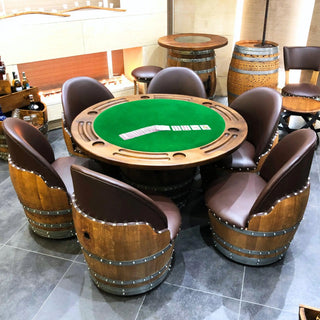
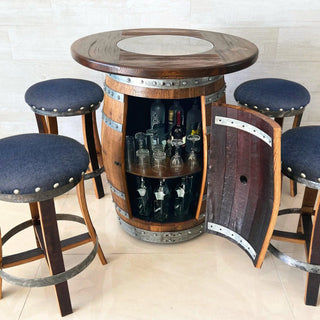
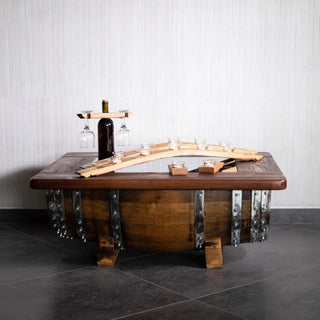
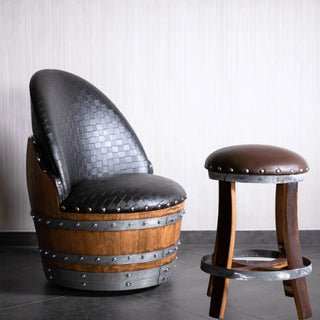
Sustainable reclaimed wood furniture sits at the intersection of two trends: rising buyer interest in environmental footprint and growing distrust of "fast furniture" sold cheaply and discarded quickly. Wine barrel furniture happens to make a strong case in both directions because every piece begins as material already in circulation — a French oak barrel that spent its first 3 to 5 years aging Bordeaux at a chateau, then would otherwise be sold for mulch, firewood, or smoking chips. The eight arguments below cover the measurable environmental case for this type of furniture. This piece sits inside our broader complete buying guide for wine barrel furniture, which covers the rest of the purchase decision. To learn more about how our family workshop sources these barrels, you can read about our process here.
1. Reclaimed oak avoids the carbon cost of new lumber
Reclaimed oak furniture skips the carbon-intensive steps of harvesting, milling, kilning, and shipping fresh hardwood lumber. New oak lumber requires roughly 1,200 to 1,500 kg of CO2 equivalent per cubic meter from forest to finished board, depending on transport distance and kiln fuel source.
A wine barrel reused as furniture has already had those carbon costs absorbed by its first life as a cooperage product. The incremental footprint of converting it into a bar or table is the labor and varnish — measured in tens of kg of CO2 equivalent, not thousands. The barrel is essentially a carbon "credit" carried forward from a use that has already happened.
Per piece of furniture, that swing is meaningful. A typical barrel bar uses roughly 0.15 cubic meters of oak. Sourcing that volume new instead of reclaimed adds roughly 180-225 kg of CO2 equivalent that simply does not happen with reclaim.
[Source: USDA Forest Service Forest Products Laboratory, "A Synthesis of Carbon Sequestration, Carbon Emissions, and Net Carbon Flux in Wood Products" (FPL-GTR-199); CORRIM (Consortium for Research on Renewable Industrial Materials) lifecycle inventory data for U.S. hardwood lumber.]
2. The lifespan is decades, not seasons
The most under-discussed sustainability argument for solid oak barrel furniture is that it lasts. The Environmental Protection Agency estimates that Americans throw out roughly 12 million tons of furniture per year, with most of it ending up in landfill. The driver is the fast-furniture replacement cycle — particleboard, MDF, and veneered pieces designed for a 3-to-7-year life.
Solid oak barrel furniture, built around the same 53-to-59-gallon Bordeaux barrels used for centuries of wine aging, routinely lasts 30-plus years with basic care. A piece that lasts 10 times longer than a fast-furniture equivalent has roughly one-tenth the lifetime environmental footprint, even before the carbon math above.
This is why we offer structural warranties measured in years, not days — the oak is built to outlive the warranty.
[Source: U.S. Environmental Protection Agency, "Advancing Sustainable Materials Management: Facts and Figures" annual report, furniture and furnishings category tonnage and recovery rates.]
3. French oak forestry is among the most regulated in the world
The French oak (Quercus petraea) used in Bordeaux cooperage comes primarily from state-managed forests under the Office National des Forets (ONF), where harvest cycles are 150-to-200 years and replanting is mandatory. The forests these barrels originate from operate under sustainable yield management — they are harvested at roughly the rate they regrow.
This matters because the carbon and biodiversity case for any reclaimed wood depends on the integrity of the original source. Wine barrel oak from Bordeaux carries an unusually strong upstream story: the forest is managed for generational continuity, not short-rotation profit. Buying a piece of furniture made from a retired Bordeaux barrel reinforces that supply chain by adding value to the second life of the wood.
[Source: Office National des Forets (ONF), "Sustainable Management of French Public Forests" guidelines; Programme for the Endorsement of Forest Certification (PEFC) France certification standard for French oak harvesting rotations.]
4. Water and fuel savings vs new lumber
Hardwood lumber production is water-intensive at the kiln-drying stage, requiring substantial energy to bring green oak from 60-80 percent moisture down to the 6-8 percent moisture furniture requires. A barrel that has been aging wine for 3-5 years is already dimensionally stable at indoor moisture content — no kiln required.
Estimates from forest products research put kiln energy at roughly 1,500-3,500 BTU per board-foot of hardwood. A barrel bar uses roughly 60-80 board-feet of oak. Skipping the kiln step on reclaimed barrel material saves on the order of 100,000-280,000 BTU per piece of furniture — equivalent to roughly 1-3 gallons of heating fuel.
Multiply across 1,527-plus orders we have shipped from our shop alone, and the cumulative kiln-fuel avoidance is meaningful at workshop scale.
5. Diverts material from lower-value waste streams
Retired wine barrels do not all become furniture. The default destinations for a chateau's spent barrels include resale as whiskey-aging barrels (typically 1 additional reuse cycle), grind-down into smoking chips, mulch, or in some cases firewood. Each of those is a valid use, but none preserves the structural and aesthetic value of the wood the way furniture does.
Converting a retired barrel into a piece of furniture extends the carbon storage life of the wood by another 30-plus years. As long as the oak is in a piece of furniture, it is not releasing its stored carbon back to atmosphere. That is a form of long-duration biogenic carbon storage — material climbing up the waste hierarchy from "burn for fuel" to "use as durable goods."
The EPA's waste hierarchy ranks reuse and remanufacture above recycling, which sits above energy recovery and landfill. Reclaimed wine barrel furniture sits at the top of that hierarchy.
[Source: U.S. Environmental Protection Agency, "Sustainable Materials Management: Non-Hazardous Materials and Waste Management Hierarchy," published guidance ranking source reduction and reuse above recycling and energy recovery.]
6. Local U.S. workshops, lower shipping carbon than imported furniture
A meaningful share of new furniture sold in the U.S. is imported from Asia, and the ocean freight + last-mile distribution carries its own carbon load — roughly 3-5 percent of the total lifecycle footprint of a typical imported piece. A barrel bar built in a U.S. family workshop and shipped LTL to a domestic address bypasses the ocean freight portion entirely.
This is not unique to wine barrel furniture, but it stacks on top of the carbon savings above. Combine reclaim material + domestic build + long lifespan, and the per-year-of-ownership footprint is a fraction of a comparable imported particleboard piece.
[Source: U.S. EPA SmartWay Transport Partnership emissions factors by freight mode; International Maritime Organization (IMO) Fourth GHG Study on ocean freight CO2 intensity per tonne-kilometer.]
7. Biodegradable at end of life — but not for decades
Solid oak with a spar varnish finish is biodegradable at end of life, unlike particleboard, MDF, or veneered furniture that contains formaldehyde-based adhesives and plastic laminates. When an oak barrel piece eventually reaches end-of-life many decades from now, the dominant material (solid oak) returns to the carbon cycle through composting or natural decay. The steel hoops are recyclable through any scrap metal stream.
The varnish layer is the only material that does not biodegrade cleanly, and a typical piece carries roughly 200-400 grams of varnish across the entire surface — a small fraction by mass.
Compare this to a fast-furniture piece where the dominant materials are formaldehyde-bonded particleboard and plastic laminate, both of which require special disposal and leach into landfill leachate over decades.
8. Refinishable instead of disposable
A wine barrel piece can be refinished — sanded lightly, re-varnished — every 5-10 years if it is in heavy commercial use, or once every 15-25 years in residential use. Refinishing is a multi-decade extension of life that fast furniture cannot accommodate because particleboard cannot be sanded and re-veneered economically.
This converts the sustainability case from a one-time purchase decision into an ongoing one. A piece you can refinish three times across its life has roughly four times the useful life of a piece that gets thrown out the first time the surface wears.
For commercial buyers, this is also a cost story: a refinished bar at year 15 costs a fraction of replacement, and the carbon footprint of the refinish is roughly 1 percent of the carbon footprint of buying new.
Headline data: barrel furniture vs new-build hardwood furniture
The numbers below are approximate per-piece comparisons for a typical bar-height piece using 60-80 board-feet of oak. They are intended as order-of-magnitude figures, not certified LCA results.
| Factor | New hardwood furniture | Reclaimed barrel furniture |
|---|---|---|
| Upstream CO2 (kg) | 180-225 | 0-20 (carried by first life) |
| Kiln energy (BTU) | 100,000-280,000 | 0 (already stable) |
| Typical lifespan | 8-20 years (variable) | 30+ years |
| End-of-life | Mixed (varnish + adhesives complicate) | Mostly biodegradable (oak + scrap steel) |
| Refinishable | Sometimes | Yes, multiple cycles |
| Source forest management | Variable | Bordeaux ONF (sustainable yield) |
[CHART: Side-by-side bar chart comparing upstream CO2 of new hardwood vs reclaimed barrel furniture]
Methodology and limits of this analysis
This is an industry-informed estimate, not a certified lifecycle assessment. Real LCA varies by specific barrel origin, transport distance, workshop energy mix, and end-use scenario. The order-of-magnitude conclusions are well-supported in the forest-products and waste-management literature, but a specific piece may sit higher or lower in any one category.
Two honest caveats: (1) Reclaimed barrel furniture is not a substitute for not buying furniture you do not need — the most sustainable piece is the one you do not buy. (2) Reclaim only works as a sustainability story if the upstream supply (the original wine barrel) was itself sustainably produced. The Bordeaux ONF chain is among the strongest globally, but verify with the maker for any specific piece.
What buyers can do
Three practical steps for buyers who care about the environmental case:
- Ask about the source. Reputable workshops can tell you the cooperage or chateau region the barrels come from.
- Buy for keeps. The sustainability math collapses if you buy a beautiful piece and resell it three years later. The case is built on multi-decade ownership.
- Refinish, do not replace. A spar varnish refresh is a multi-hundred-dollar service that adds 15+ years to the piece. Compare to the cost and footprint of buying new.
Our family workshop sources barrels from Bordeaux-region cooperages and finishes each piece for a multi-decade life. If you want to know more about how the barrels are selected and built, read about our family workshop here.