
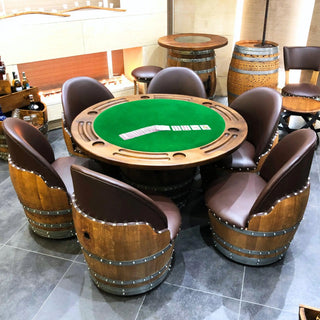
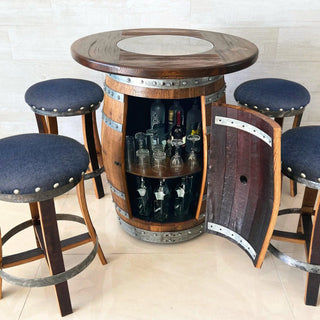
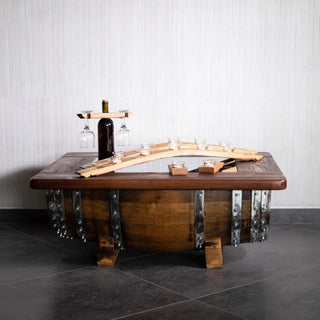
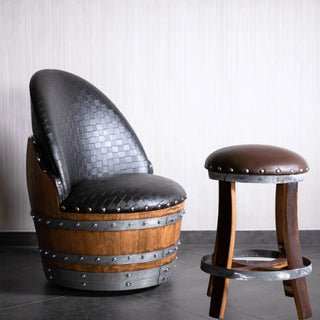
Knowing how to find an authentic barrel furniture maker matters more than picking the perfect piece. A well-built wine barrel bar costs $800 to $2,500, ships by freight, and is non-returnable once damaged in transit by a sketchy seller. The vetting work below takes about 30 minutes per maker and rules out 95 percent of bad actors before money changes hands. This checklist plugs into our broader complete buying guide for wine barrel furniture. If you want to see what a real family workshop's "about" looks like, ours is here.
Time required: 30-45 minutes per maker. Skill level: Beginner; no special tools.
Tools and materials
| Tool | Purpose |
|---|---|
| Etsy / Shopify / Wayfair search | Find the maker's storefront |
| BBB.org or state Secretary of State website | Verify business registration |
| Google Reverse Image Search | Detect stolen listing photos |
| Trustpilot, Etsy reviews, Google reviews | Confirm sales history |
| A blank email draft | Test response time and tone |
Step 1. Start with the storefront, not the social ad
The most common pattern in furniture scams is a paid social ad pointing to a slick one-page store with no business history. Skip the ad, search the maker's name on Etsy, Shopify-hosted domains, Wayfair, and Houzz. A legitimate U.S. workshop will typically appear in at least one of those marketplaces with a sales record.
If the only place a "maker" exists is a Facebook or Instagram ad funnel pointing to a Shopify checkout, treat that as a yellow flag and require all subsequent steps to pass.
Step 2. Look at the sales count and review history
A legitimate handmade furniture workshop has cumulative sales running into the hundreds or thousands, not dozens. On Etsy, the sales count and star rating are public on every shop page. Our shop, for reference, sits at 1,527-plus sales with a 4.9-star Star Seller rating, those numbers are visible to anyone on the platform.
Sales count under 50 isn't automatically disqualifying for a newer maker, but it should push you harder on every other step. Sales count over 500 with a 4.8+ rating is a strong baseline of legitimacy on its own.
[Source: Etsy Seller Handbook, "Star Seller Program" eligibility documentation on message response rate, shipping on time, 5-star reviews, and order minimums.]
Step 3. Verify business registration
Look up the maker's business name on the state Secretary of State business search for whatever state they list as their workshop location. Every legitimate U.S. business is registered as an LLC, corporation, or sole proprietorship. The search is free and takes 60 seconds.
You're looking for: a registration that predates the storefront, a registered agent address that matches or sits near the claimed workshop location, and a status of "active" or "good standing." A storefront claiming a decade of business with a registration filed two months ago is a major red flag.
Step 4. Read the customer reviews in detail, not just the star rating
Star ratings are easy to game; review text is harder. Spend 10 minutes reading actual customer reviews. Look for:
- Photos uploaded by customers (real buyers post real photos)
- Specific details about the piece (dimensions, fabric color, finish)
- Mentions of customer service interactions (response time, replacement handling, communication style)
- Mix of glowing and constructive feedback (all-5-star with no nuance suggests filtered reviews)
A shop with 200 reviews where 180 mention specific product details and 30 include customer photos is a real shop. A shop with 200 reviews that all read like marketing copy is suspect.
Step 5. Look at the listing photos forensically
Pull 2-3 product photos from the listing and run them through Google Reverse Image Search (or TinEye). Legitimate maker photos appear on the maker's own storefront and possibly their own social accounts. Stolen photos appear across multiple unrelated stores or stock-image sites.
If a "maker" is using photos that appear on five other Shopify stores under different brand names, you're looking at a drop-shipping operation, not a workshop. The piece you receive will likely be from a single overseas warehouse, not the family workshop pictured.
Step 6. Ask for sourcing transparency
Email the maker before purchase with a simple question: "Where do you source your barrels?" A real workshop has a real answer, typically a wholesaler of retired Bordeaux-region or American whiskey barrels, often the same supplier for years. The answer should include a region (Bordeaux, Napa, Kentucky) and a barrel type (53-to-59-gallon, American Standard, hogshead).
Vague answers ("we have our sources," "proprietary supply chain") on a question this routine is a red flag. A maker who has been buying barrels for years has nothing to hide about the supply chain.
Step 7. Ask for in-progress or behind-the-scenes photos
Most legitimate workshops have a phone full of behind-the-scenes shots, barrels being cut down, staves being wire-brushed, varnish coats in progress. Many post them on Instagram or Pinterest. Ask: "Do you have any shop or process photos you can share?"
A real workshop replies within a day with a few candid photos. A drop-shipper replies with the same polished product photos from the listing, or asks for a few days, or simply doesn't respond. This single question filters out a large share of bad actors.
Step 8. Verify the return and warranty policy in writing
A legitimate workshop publishes a return and warranty policy on its storefront and is willing to repeat it in an email before purchase. Ask: "Can you confirm the return window, restocking fee if any, and warranty terms for this piece?"
You want a written response with specific numbers, "14-day return window, 15 percent restocking, lifetime warranty on structural defect, 1-year warranty on finish", not a marketing-flavored deflection. If the maker won't commit to specifics in writing before a sale, they won't commit to them after a sale either.
Step 9. Confirm off-platform when in doubt
For higher-value purchases ($1,500+), it's reasonable to ask if the maker can be reached by phone. A legitimate U.S. workshop usually has a phone number, even if email is the preferred channel. Five minutes on a phone call with the actual maker confirms the operation is real in a way no website can.
Reasonable asks: "Could I call you with a few questions about this piece?" or "Do you have a number where I could reach the workshop directly?" If both requests are stonewalled, that's information.
Step 10. Test response time and tone
Send a simple, low-stakes pre-purchase question and measure both how quickly the maker responds and how the response reads. A family workshop typically responds within 1-2 business days with a personal, specific reply. A reseller often responds within an hour with a generic templated reply, or after several days with a copy-paste answer that doesn't address your specific question.
Both extremes are signals. The best signal is a 1-2 business day reply that reads like a person who knows the product wrote it.
Common mistakes buyers make when vetting
Mistake 1: Trusting a high star rating without reading reviews. Star ratings can be filtered or bought; review text is harder to fake.
Mistake 2: Assuming a slick website means a legitimate operation. Modern templates make any drop-shipper look professional. Sales history and behind-the-scenes evidence matter more than design.
Mistake 3: Skipping the pre-purchase email. A 2-minute email exposes more than 30 minutes of browsing.
Mistake 4: Paying off-platform. Wire transfers, Zelle, and Venmo have no buyer protection. Stick to credit cards or Shopify Payments.
Mistake 5: Ignoring the "too cheap to be true" signal. An authentic 53-to-59-gallon Bordeaux barrel bar priced 50 percent below the market average isn't a deal; it's either a fake or a damaged piece.
[Source: Better Business Bureau (BBB) "Scam Tracker" annual report on online purchase scams; Federal Trade Commission (FTC) Consumer Sentinel Network data on furniture and home goods complaints.]
[Source: Federal Trade Commission, "Online Shopping" consumer guidance (consumer.ftc.gov) on verifying sellers and using payment methods with chargeback protection.]
10-point legitimacy checklist
Print this and run it on any maker before purchase. 8 of 10 is a reasonable threshold; below 6, walk away.
- Appears on a major marketplace (Etsy, Shopify, Wayfair, Houzz) with a public sales record
- Sales count consistent with claimed business age
- Business registration verifiable on state Secretary of State website
- Customer reviews include customer-uploaded photos and specific product detail
- Listing photos don't appear on multiple unrelated stores via reverse image search
- Maker answers sourcing questions with specific region and barrel type
- Maker can share behind-the-scenes process photos on request
- Return and warranty policy provided in writing before purchase
- Reachable by phone or willing to schedule a call for higher-value orders
- Response time 1-2 business days with personal, specific replies
Run this once, and the right family workshop becomes obvious. If you want to read about how our shop fits this checklist, our family workshop page is here.