
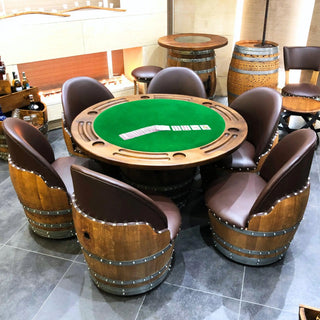
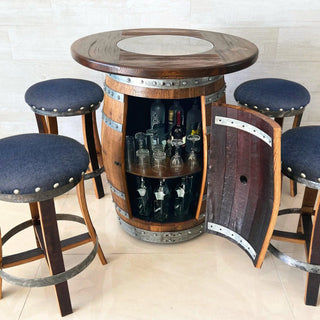
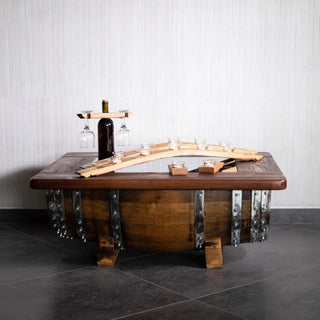
Short answer: Move barrel furniture in pieces, in moving blankets, on a dolly, with two people. Store it in a climate-controlled area, away from bare concrete and under breathable covers. For insurance, photograph each item and record its current price. Ask your agent about coverage for property away from your premises. The Bistro Pub Set (from $1,404) at Oak Wood Wine Barrels is a finished barrel, a removable 35.4-inch round top and a foot rail, and that's exactly how it should go: in pieces.
Prices as of October 6, 2026; each link shows live stock.
What should you know before moving day?
The size of each piece and each opening it has to go through. Barrel furniture is heavy, round and cumbersome, and most damage is done at door frames, stair turns and truck ramps.
Sizes from our product pages (±5–10%, since every barrel is different):
| Piece | Size |
|---|---|
| Finished barrel (Bistro Pub Set) | 27.4 × 27.4 × 37.2 in |
| Round top | 35.4 in across, 2 in thick |
| Foot rail, Wine Barrel version | 37 × 37 in outside |
| Barrel Stool | 18.9 × 18.9 × 27.6 in |
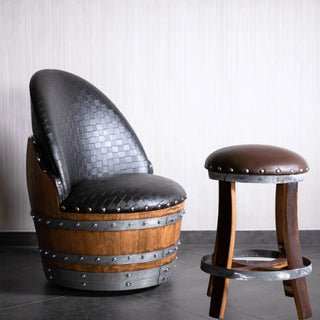
| Barrel Lounge Chair | 28.2 × 27.8 × 36.9 in |
Measure doorways, hallways, stair landings, elevators and the vehicle before loading anything. A 35.4-inch top may need to fit through a door on its edge. For a weight to check against your vehicle or a venue's load-in rules, call Oak Wood Wine Barrels at (832) 933-8787 before your move day.
How do you move a barrel bar without damaging it?
1. Take it apart
Remove the round top from the barrel. If you put it on with angle brackets, unscrew them first. Treat stools and chairs as individual items, empty any cabinet out completely, and put screws and small hardware into a labeled bag taped to the piece it came from. Take a picture of the setup before you take it apart, so it goes back together the same way.
2. Wrap every piece
Wrap each barrel, top and chair in a moving blanket, and secure the blanket with stretch wrap. Don't put tape directly onto the wood, as it can lift the finish when you take it off. Pad the edges that are hit first: the rim of the round top and the chime, the rim at either end of the barrel. If your top has a glass center, pad both faces, not just the rim.
3. Lift and roll the right way
- Two people for every barrel and every top. Pick up a barrel by the body, never by the top or a hoop.
- A four-wheel furniture dolly for barrels and cabinets on flat floors.
- A hand truck with a strap for steps, and one person below to take the weight.
- Chairs on wheels: the barrel chairs have wheels under them. Roll them over smooth floors, but don't force them over thresholds and rough patches; lift them.
4. Load and strap the vehicle
Heaviest pieces go in first, standing upright against the front wall. Strap each row to stop anything from sliding under braking. Tops travel either on edge (padded and strapped) or flat on blankets with nothing on them. Small pieces and padding fill the gaps. Use an enclosed truck or van; an open pickup bed will expose the finish to road grit and moisture.
How should you store barrel furniture between events?
The same way you'd store indoor furniture, because that's what it is.
- Climate-controlled space. Big temperature and humidity changes cause hoops to loosen and seams to open up over time. See Humidity Math - The One Spec That Determines Indoor Barrel Lifespan.
- Off bare concrete. Slabs are cool and can be damp. Set pieces on blocks, rugs, or pallets.
- Breathable covers. Cotton sheets or moving blankets keep dust out of the grain. Don't cover pieces with plastic sheeting, which traps moisture against the wood.
- Nothing heavy on the tops. Store round tops on edge with support or flat with nothing on top.
- Out of sunlight and away from heaters or vents.
- Check every few weeks. Look for loose hardware, dust in the upholstery and anything that has shifted.
What insurance applies to furniture used at events?
That depends on your policy, so go to your agent first. Questions to consider:
- Do I have business property coverage for furniture in transit and at other locations? Property that travels between locations is often insured under an inland marine policy or an equipment floater.
- Are there any per-item limits that a bar set could go over?
- How fast can you issue a certificate of insurance? Many venues ask vendors to provide one, naming the venue, before load-in.
Keep an inventory your insurer can use: a photo of each piece, its product name, dimensions, receipt and current price. The product pages show today's prices, so a printout or screenshot dated near renewal is easy proof of replacement cost. For example, the Bistro Pub Set with four stools is $2,754 at the time of writing.
What should you check before each event?
| Check | Pass |
|---|---|
| Hoops | Seated evenly, none slipping |
| Top | Sits flat; brackets tight if fastened |
| Stability | No rocking on a hard floor |
| Finish | No new deep scratches or bare spots |
| Foot rail | Screws snug |
| Upholstery | Clean and dry |
| Wheels | Free of debris; chairs roll straight |
Five minutes with this list before load-in beats discovering a problem in front of guests. For fixes, see How to Fix a Loose Hoop, Squeaky Stave, or Scratched Barrel Top.
Which pieces travel best?
| Piece | Price | Breaks down into | Travel note |
|---|---|---|---|
| Bistro Pub Set | from $1,404 | Barrel, round top, foot rail (stools optional) | Top lifts off |
| Double Bar Set | from $2,808 | Two barrels, two tops, two foot rails | Two moderate loads instead of one large one |
| Barrel Stool | $337.50 | One piece | Move upright; don't stack |
| Barrel Lounge Chair | $1,079.10 | One piece, on wheels | Rolls on smooth floors |
Pieces that come apart are easier on your crew and your doorways. See all the sets in Full Barrel Sets.
What mistakes do event crews make most?
- Moving a bar with the top still attached.
- Skipping blankets "because it's a short trip."
- Taping directly onto the finish.
- Putting pieces in an unconditioned garage "just for the summer."
- Rolling chairs over thresholds.
- Requesting a certificate of insurance the morning of the event.
Oak Wood Wine Barrels ships free within the continental U.S., and larger orders are delivered by appointment. Houston delivery is available anywhere in town. Local pickup is by appointment.
Frequently asked questions
How do you move a barrel bar without damaging it?
Take the top off, wrap each piece in moving blankets, transport the barrel using a dolly and two people, and strap everything into an enclosed vehicle.
Can barrel furniture go in a storage unit?
Yes, if it's climate-controlled. Keep things off bare concrete and use breathable covers, not plastic.
Should you wrap barrel furniture in plastic?
Only over blankets, for the move itself. In storage, plastic traps moisture against the wood.
What insurance covers furniture used at events?
Ask your agent if your business property coverage includes items in transit and at other sites, often written as inland marine or an equipment floater, and how quickly they can issue a certificate of insurance.
How big is a finished barrel for moving purposes?
The barrel of the Bistro Pub Set is about 27.4 inches wide and 37.2 inches tall, and the round top has a diameter of 35.4 inches.