
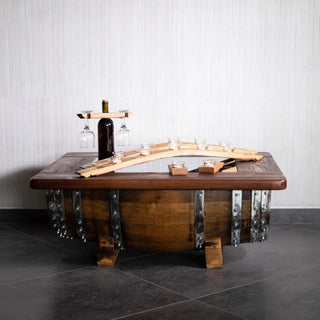
Short answer: September is National Bourbon Heritage Month in the U.S., and many whiskey fans celebrate all American whiskey that month. Seven ways to mark it at home: a four-pour flight, a blind tasting, a five-bottle September shelf, a distillery visit, a label-reading night, a gift to a fellow collector, and one ritual that outlasts the month. The Perfect Duo Gift Pack ($104) from Oak Wood Wine Barrels comes with a 5-glass stave flight shooter and a 5-candle stave centerpiece, and the 5-Bottle Stave Wall Rack ($247.50) holds the month's rotation.
Prices as of October 6, 2026; each link shows live stock.
Why is September whiskey month?
It's because of bourbon. In 2007, the U.S. Senate passed a resolution designating that September as National Bourbon Heritage Month, and distillers and drinkers have marked the occasion ever since. In 1964, Congress had already declared bourbon a distinctive product of the United States. Many people broaden the month to rye, Tennessee whiskey, and every other American whiskey, which is why some call it American whiskey month.
American whiskey was a $5.1 billion category in 2025, according to the Distilled Spirits Council, as reported by The Whiskey Wash. That's a big category to celebrate.
But none of the ideas below needs September. Use them for any fall weekend and pencil the whole set in for next September.
What are seven ways to mark it at home?
1. Pour a four-glass flight that changes one thing
Pick out four whiskeys that differ in only one way so you can taste the effect of that one thing:
- Proof: the same style at rising strength.
- Age: the same distillery at different ages.
- Grain: a wheated bourbon, a high-rye bourbon, a traditional bourbon and a straight rye.
Pour about an ounce each, lightest first, and set out water and plain crackers between the pours. The Perfect Duo Gift Pack ($104) contains a stave flight shooter that sets up five small pours (shot glasses included). The Party Planner Gift Pack ($166.50) is for a larger group and features two flight shooters, two cigar ashtrays and a gravity-glass display.
2. Run a blind tasting
The fun is in the discovery. Pick three whiskeys that are in the same price range. Have someone who is not tasting pour them into numbered glasses out of sight. Everyone tastes, ranks and guesses, and then you reveal. Jot the results down in a notebook kept at the bar; after a few Septembers you'll have your own record of what you really like.
3. Build a five-bottle September shelf
Pick five bottles for the month and put the rest away: an everyday pour, a step-up, one from a distillery you've never tried, a rye, and a wildcard. A short list gets finished; a crowded bar gets overlooked. The 5-Bottle Stave Wall Rack ($247.50) holds any five bottles on Wine Barrel staves and metal hoops, about 37.2 inches tall, with back hooks installed. Use it for the bottles you are drinking now, and store sealed bottles upright, because long contact with high-proof spirit is hard on corks.
4. Visit a distillery near you
You don't have to go to Kentucky. There may be a craft distillery within driving distance, as many states have them now. Always check the tour times beforehand, take notes on what you taste, and bring home a bottle that you can't get in your local store. It takes center stage in your next flight.
5. Spend one evening learning the label
Most of what's on a bottle can be explained with a few terms:
- Straight bourbon: at least two years old. If it is under four, the label must state the age.
- Bottled-in-bond: distilled by one distillery in one distilling season, aged at least four years and bottled at 100 proof.
- Single barrel: bottled from one barrel instead of a blend of multiple barrels.
- Small batch: a blend of a limited number of barrels; the term is not defined in law.
Pour three bottles with different label terms and read the labels as you drink.
6. Give a fellow collector something made of oak
Collectors already own the bottles. Give them something for the way they drink. The Hoop Side Table ($391.50) is an oak barrel top on metal hoops, a drink table to put beside a reading chair. If they have a Whiskey Barrel, the Foot Rail ($236.50) has a Bourbon/Whiskey Barrel version, 34.5 inches outside with 24 inches between supports, that converts it to a standing bar.
7. Start one ritual that outlasts the month
Pick something small: a Sunday pour once a month with a friend, a new bottle popped on the first of the month, or three words written down for every pour. Place-based rituals stick. It's the chair, the side table and the shelf you set up in September that carry the habit into March.
How can you fit all seven into one month?
| Week | Do this |
|---|---|
| Week 1 | Clear the bar and build the five-bottle shelf (3). |
| Week 2 | Host the four-pour flight (1). |
| Week 3 | Visit a distillery (4) and read the labels you bring home (5). |
| Week 4 | Run the blind tasting (2), give the gift (6) and start the ritual (7) on the last night. |
Too much? Pick two. The flight and the five-bottle shelf need the least planning.
What gift suits a whiskey lover?
| Gift | Price | Why it fits |
|---|---|---|
| Perfect Duo Gift Pack | $104 | Flight shooter for tastings, plus a candle centerpiece |
| Party Planner Gift Pack | $166.50 | Two flight shooters, two cigar ashtrays, a gravity-glass display |
| Foot Rail (Bourbon/Whiskey Barrel version) | $236.50 | Turns a barrel they own into a bar |
| 5-Bottle Stave Wall Rack | $247.50 | A shelf for their September five |
| Hoop Side Table | $391.50 | The drink table beside their chair |
All five are from Oak Wood Wine Barrels. The packs, the rack and the table are handmade from oak Wine Barrels. The foot rail is steel. Shipping to the continental U.S. is free. In-stock orders ship within five business days. More small pieces are in Accessories.
For the story behind the barrel itself, see National Bourbon Heritage Month: The Story Hidden Inside Every Oak Barrel and Why Bourbon Must Age in New Charred Oak.
Frequently asked questions
Is September Bourbon Heritage Month or American Whiskey Month?
In 2007, the U.S. Senate passed a resolution naming September National Bourbon Heritage Month. Many people celebrate all American whiskey during the month.
Why can't bourbon barrels be reused for bourbon?
Bourbon must be matured in new, charred oak containers. Used barrels move on to age other spirits and beer, or become furniture and planters.
What is the difference between a Whiskey Barrel and a bourbon barrel?
A bourbon barrel is a Whiskey Barrel that had bourbon in it. For bourbon, it has to be new, charred oak. Standard American Whiskey Barrels hold around 53 gallons.
What is a good gift for a man who loves bourbon?
Something for the way he drinks it: a flight shooter pack for tastings ($104), a side table next to his chair ($391.50), or a foot rail to turn his Whiskey Barrel into a bar ($236.50).
How should you store whiskey bottles?
Stand them upright, away from direct sun and away from heat. Keep the cork or cap on opened bottles.