How is a wine barrel made? A Bordeaux-type wine barrel is built by a master cooper through a sequence of roughly 60 hand-and-machine operations spread across two to three years, starting with the selection of slow-grown French oak from forests like Tronçais and Allier, followed by splitting (never sawing) the wood into staves along the grain, air-seasoning those staves outdoors for 24 to 36 months, then shaping, fitting, and toasting them over an open flame into a 225-liter (about 59-gallon) vessel held together by metal hoops and zero adhesive. Every step is governed by hundreds of years of accumulated cooperage knowledge, and every step affects how the finished barrel will season the wine that ages inside it.
The same barrels we rebuild into furniture in our family workshop started life this way. Understanding how a Bordeaux barrel is built explains why authentic wine barrel furniture has the character it has — and why it lasts decades after the cooperage's original purpose is complete.
This is a long read because the process deserves the space. There is a 10-term glossary at the end for anyone who wants the vocabulary in one place, and a fuller A-Z glossary in our companion piece The Glossary Every New Barrel Furniture Buyer Should Bookmark.
Step 1: Choosing the forest and the tree
The story starts in the forest. Bordeaux barrels are traditionally built from two species of French oak: Quercus petraea (sessile oak) and Quercus robur (English oak), grown in managed forests in central France — Tronçais, Allier, Nevers, and Vosges are the most famous appellations for Bordeaux-style wine cooperage. Limousin oak, often listed alongside these, is a more porous, higher-tannin oak that is traditionally associated with Cognac and spirits cooperage rather than fine Bordeaux red-wine production; some modern cooperages still use it selectively, but it is the outlier in the Bordeaux barrel lineup. Trees are selected at 150 to 230 years of age, well after the tree has produced the slow, tight grain that cooperage requires.
Slow growth matters because it produces fewer, denser growth rings per inch — typically 6 to 12 rings per inch in cooperage-grade oak, compared with 3 to 5 in furniture-grade oak. The tighter the rings, the more uniform the wood's moisture exchange with wine and the more controlled the tannin contribution. According to the French ONF (Office National des Forêts), which manages many of the cooperage forests, only a small fraction — commonly cited in the range of roughly 5 to 25 percent depending on stand quality — of any given oak stand ultimately makes the grade for premium barrel production [VERIFY: precise ONF-published cooperage-grade yield figure; figure varies by forest and by cooperage standard].
Step 2: Splitting (never sawing) the staves
This is the step that surprises most people. Cooperage staves are not sawn from logs the way furniture lumber is. They are split — wedged apart along the natural grain of the wood with a maul and froe. The reason is structural: a sawn stave cuts across the wood's natural fibers, opening cell walls that would leak wine. A split stave follows the grain, leaving the wood's cellular structure intact and effectively waterproof.
The downside is yield. A log that would produce 70 to 80 percent usable lumber when sawn produces only 20 to 25 percent usable stave material when split. The other 75-plus percent goes to firewood, secondary products, or back into the soil. This yield cost is built into the price of every premium Bordeaux barrel, and it is the single biggest reason cooperage oak is more expensive than the same species cut for furniture.
A finished stave is approximately 95 cm long (about 37 inches), 5-10 cm wide (2-4 inches), and 22-27 mm thick (just under an inch). A standard Bordeaux barrel uses 28 to 32 staves.
Step 3: Air-seasoning for 24 to 36 months
Split staves go straight to outdoor air-seasoning yards, where they are stacked in cross-hatched piles and left exposed to weather for 24 to 36 months. This is not kiln drying. The wood needs to spend full seasonal cycles outdoors — rained on in winter, baked in summer, frozen and thawed — for two specific reasons.
First, moisture content has to equilibrate slowly. A sudden drop in moisture (which is what kiln drying does) causes the wood to crack and warp microscopically. Slow outdoor seasoning lets moisture leave at a controlled rate, producing dimensionally stable staves.
Second, harsh wood compounds have to leach out. Green oak contains aggressive tannins and other extractives that would make the finished wine taste astringent and green. Rain water carries these out of the wood over time, leaving behind the rounder, sweeter aromatic compounds (lactones, vanillin precursors, volatile phenols) that the wine industry actually wants.
The 24-to-36-month range is not arbitrary. Major cooperage research from institutions like the French ISVV (Institut des Sciences de la Vigne et du Vin) has shown that seasoning under 24 months produces measurably harsher wines, while seasoning over 36 months offers diminishing returns on cost [Source: ISVV published research on oak seasoning and wine quality — VERIFY citation]. Three years is the comfortable industry standard for premium production.
Step 4: Shaping the staves
After seasoning, staves go to the cooperage workshop, where each one is hand-shaped on a stave-shaping plane. The stave gets:
- A slight curvature along its length (the bilge — the bulge in the middle of the barrel)
- A jointing angle on both long edges (so adjacent staves meet at the precise angle to form a circle)
- A taper toward both ends (so the barrel narrows at the heads)
- The croze — a groove cut around the inside near each end, where the barrel head will eventually seat
A skilled cooper shapes each stave in 4-7 minutes. The accumulated geometry matters: 28 staves whose joint angles are off by half a degree each will not close into a watertight circle. This is among the most experienced-hands work in any traditional craft.
Step 5: Raising the barrel
Shaped staves are stood up inside a temporary iron hoop called a raising-up hoop, which holds them in a rough circle at one end while the other end fans open like a flower. At this stage, the barrel looks like a wooden teepee, wide at the top and tight at the base.
The cooper now begins the most visually dramatic step in the process.
Step 6: Toasting and bending over fire
A small wood fire — traditionally oak chips from the same wood being worked — is built inside a brazier. The fanned-open end of the barrel is placed over the fire while the staves are simultaneously dampened on the outside with water. As the inside dries and the outside stays moist, the staves slowly become pliable enough to bend.
The cooper progressively tightens cable winches or ratchet straps around the open end of the barrel, pulling the fanned staves closer together as they soften. Over 30-45 minutes, the staves bend smoothly into the classic barrel shape and the cooper drives temporary hoops down to lock them in place.
This is also the step where the toast level is set. The length of time the inside of the barrel sits over the fire — and the temperature of that fire — determines whether the finished barrel is light toast, medium toast, medium-plus toast, or heavy toast. Toast level dramatically affects the aromatic compounds the barrel will contribute to the wine: light toast emphasizes fresh oak and sweet vanilla notes, while heavy toast emphasizes smoke, caramelized sugar, and clove-like spice. Wineries specify toast level to match the wine style.
Bordeaux barrels are typically built to medium or medium-plus toast.
Step 7: Fitting the heads
The two ends of the barrel (the heads) are made separately. Several head pieces are jointed edge-to-edge into a circle, secured with dowels, and shaped to fit precisely into the croze groove cut earlier into the inside of the staves. Heads are inserted at slight pressure, then the temporary hoops are replaced with the permanent galvanized steel hoops that hold the barrel together for life.
A standard Bordeaux barrel has four to six hoops: a head hoop nearest each end (also called a chime hoop), a quarter hoop further in, and a bilge hoop at the widest point of the barrel.
No glue. No nails. The barrel holds together through the precise geometry of the stave joints and the compressive force of the hoops alone.
Step 8: Drilling the bunghole
A 50 mm (about 2-inch) hole is drilled through the bilge of the barrel — the widest point in the middle of one stave. This is the bung hole, through which wine will be filled, sampled, topped up, and eventually drained. A tapered wooden plug (the bung) seals it during aging.
Step 9: Pressure testing
Finished barrels are filled with hot water at low pressure and inspected for leaks. The wood swells slightly during this test, sealing any micro-gaps in the stave joints. A barrel that fails the pressure test is repaired or rejected. A barrel that passes is dried, branded with the cooperage mark, and shipped to the winery.
Step 10: First fill at the winery
The barrel arrives at the winery clean, dry, and ready for its working life. It is filled with wine — most commonly red Bordeaux blends, but the same barrel format is used worldwide for Cabernet, Merlot, Pinot Noir, Chardonnay, and aged whites. Over the next 18 to 24 months, the wine and the oak exchange compounds. The wine extracts tannins, vanillin, lactones, and toast compounds from the wood. The wood absorbs a small amount of wine into its outer cell layers — typically 2-4 liters per barrel — which it will carry for the rest of its existence.
After two to five vintages, the barrel's aromatic contribution has diminished to the point where most wineries retire it. That is where the second life begins. (For the long-game on what that second life looks like, see our companion piece on whether real wine barrel furniture will outlast you.)
Step 11: Second life — furniture
Retired Bordeaux barrels arrive at workshops like ours, fully cured wood that has spent at least five years (often more like seven to ten years total: seasoning + aging) becoming the most dimensionally stable, character-rich material in the woodworking trade. The interior carries the toast char and a permanent wine stain. The exterior carries the cooperage's branding, the marks of the winery's racking and bottling cycles, and decades of accumulated character.
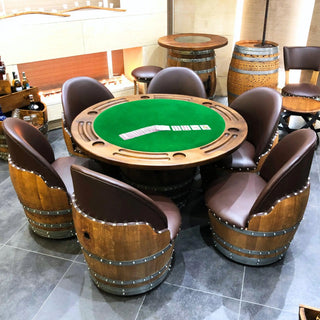
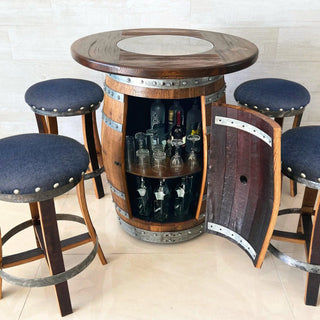
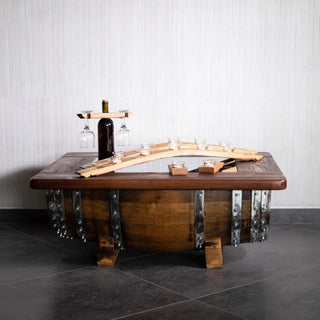
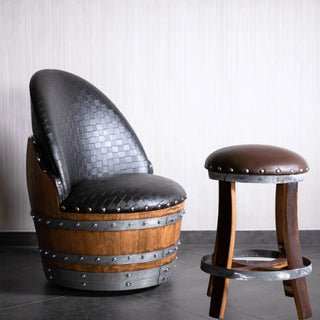
We rebuild these barrels into bars, tables, chairs, stave wall racks, and signage in our family workshop. The construction method honors the cooperage that made them: we keep the hoops, preserve the stave joints, leave the interior toast visible where it tells the story, and finish the exterior with spar varnish that protects the wood for another 30 to 50 years of indoor life. The exterior surface treatment is covered in detail in our wire-brushed staves explainer.
When someone asks us why authentic barrel furniture costs more than reproduction "barrel-look" furniture, this is the full answer. The material has been alive in the trade for at least seven years before we touch it. That history cannot be shortcut.
The 10-term mini-glossary
Stave — One of the curved wooden boards that forms the side wall of a barrel. A Bordeaux barrel uses 28-32 staves. Example: "Each stave is split from a log, not sawn, so the wood fibers stay intact." See also: hoop, croze, bilge.
Hoop — The metal band that compresses the staves together. A typical Bordeaux barrel has 4-6 hoops, named by position (chime, quarter, bilge). Example: "We preserve the original cooperage hoops when we rebuild a barrel into furniture." See also: stave, chime, bilge.
Croze — The groove cut around the inside of the staves near each end, into which the barrel head fits. Pronounced "kroze." Example: "The croze is the geometry that holds the barrel together without glue." See also: head, stave.
Chime — The angled edge of the staves at each end of the barrel, where they extend just past the head; also the flat rim that forms the top edge of a barrel. Example: "Foam corner protectors go on the chime of every barrel during transport." See also: head hoop, stave.
Bilge — The widest point of the barrel, in the middle of its length. Example: "The bunghole is drilled through the bilge of one stave." See also: bunghole, stave.
Head — One of the two flat circular ends of the barrel, made from several jointed pieces of oak. Example: "Branded barrel-head signs are one of the most common pieces we engrave for hospitality clients." See also: croze, head hoop.
Bung — The tapered wooden plug that seals the hole in the middle of the barrel during wine aging. Example: "Original bungs are sometimes left in place as a decorative detail on furniture pieces." See also: bunghole.
Bunghole — The 50mm drilled hole through the bilge of one stave, used for filling, sampling, and draining the barrel. Example: "The bunghole is often filled with a custom inlay on a finished bar top." See also: bung, bilge.
Toast — The level of charring on the interior of the barrel produced by the fire during the bending process. Specified as light, medium, medium-plus, or heavy. Example: "Bordeaux barrels are typically built to medium or medium-plus toast." See also: char level (whiskey-barrel equivalent).
Cooper — The craftsperson who builds barrels. The trade is called cooperage. A working cooper today has typically apprenticed for 4-7 years before being qualified to build barrels independently. Example: "A skilled cooper shapes each stave in 4-7 minutes." See also: cooperage, tonnellerie.
Sources referenced
- French ONF (Office National des Forêts) — cooperage oak forest management practices [VERIFY direct citation for yield figures]
- ISVV (Institut des Sciences de la Vigne et du Vin) — research on stave seasoning and wine quality [VERIFY]
- USDA Forest Products Laboratory — white and European oak wood properties
- Tonnellerie cooperage trade publications — historical and contemporary cooperage methods
- Wine science literature on oak aging chemistry (Vivas, Glories, and related researchers on tannin and aromatic extraction)
The barrel that becomes your bar, your table, or your chair has been built by hands following methods that predate most of modern industry. When the wood is this old and this honest, it is worth understanding where it came from.